CONTENTS
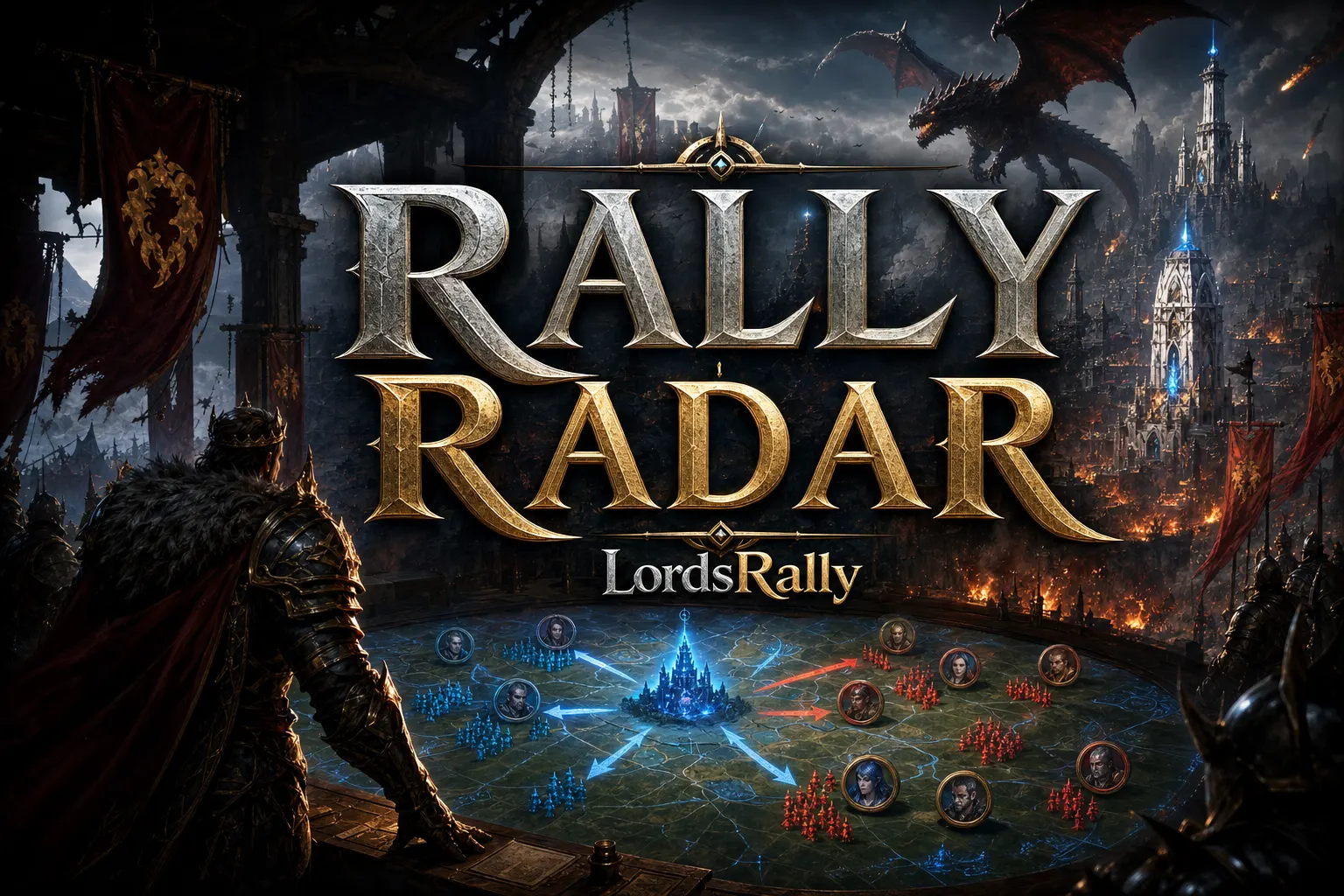
In Wonder matchups, the real game starts not when everyone hits the field, but when you’ve already seen how the enemy is structured. LordsRally works like a full-field intelligence tool here: it generates a notification the moment an event happens, sends it to your WhatsApp or Telegram group within 1–3 seconds, and does not require you to keep a computer open. You can find the full command list on the commands page, the field-side meaning of the features in the features section, and more strategy in the blog archive.
Why reading the matchup before battle changes everything
Most losses in Wonder are not caused by a power gap, but by a matchup that was read wrong. If you know in advance which guilds form the backbone of the opposing group, which ones stay in a support role, and which side will absorb the pressure, you won’t show up empty-handed on Wonder day.
The critical point here is this: instead of looking at individual player names, you need to read the group structure. Because a matchup tells you not only who is across from you, but also how many different call chains you’ll face at the same time. For example, if two major Baron guilds land in the same group, that side usually has tighter rally coordination. If the same volume is spread across different groups, defense tends to be more fragmented.
That’s where LordsRally’s advantage shows up. The output from !barongruplari and !kupagruplari does not just give you a list; it gives you a working surface where you can quickly break down the logic of the matchup. Having 78+ commands in-game is nice, but on the Wonder side, what really matters is reading the right group with the right command at the right time. That’s why the healthiest way to interpret a matchup is not from a single source, but from a combination of group lists + live alerts + leaderboards.
What do !barongruplari and !kupagruplari show you?
The value of these two commands is that they read the enemy as a structure, not just as names. !barongruplari pulls the Baron-side groups, while !kupagruplari pulls the Cup-side groups, almost like an Excel export. From those exports, you can tell where the same guild repeats, which group looks heavier, and where the real backbone sits.
In practice, you should look at three things:
- Number of top guilds per group: If a group has two or three strong guilds together, that group can recover faster after a single rally call.
- Repeating tags: If the same guild names keep appearing across different analyses, they are usually the core roster.
- Balance of distribution: Sometimes a group that looks crowded on paper is actually packed with low-density support guilds. That’s when appearances can be misleading.
Let’s make it concrete: if !barongruplari shows three Wonder-focused guilds in Group A, but in Group B you only see one main guild and a few mid-tier guilds, B may look calmer on paper. But if you also check median power with !wow, and B’s P50 value comes out much more balanced, individual player quality there may actually be more solid. So the issue is not just lining up big names; it’s reading the internal rhythm of the group.
That’s why !barongruplari and !kupagruplari should not be read alone, but together with the real-time structure described on the features page. The matchup list tells you who fell with whom; the bot’s fast alerts confirm how that structure behaves on match day.
The strongest group is not always the most dangerous one
The most common mistake in Wonder prep is assuming the group with the highest power is automatically the primary target. In reality, the most dangerous side is sometimes the one that is slightly weaker in power but much tighter in organization. !barongruplari and !kupagruplari let you make exactly that distinction.
Think about it like this:
- If one group has a massive single guild but weak support, the pressure center stays in one place.
- If another group has three upper-mid-tier guilds together, they can open multiple lanes at once.
- If a group repeatedly shows up near the top in
!k71and!wowoutputs, that side is not just strong, but also organized.
Making that distinction before the match starts saves you time directly. For example, if part of the enemy side recently got stronger through migration, you can also check that movement with !gelengoc and !gidengoc. If a certain group gained power transfer in the last 24 hours, you no longer read it as if it were still its old version. Likewise, if you notice a clear lack of leaders in a Wonder group, the lost/captured leader alerts and active shield-drop notifications show the risk of sudden collapse on that side.
The key point is this: !barongruplari and !kupagruplari do not give you a static photo—you make that photo dynamic with live alerts. If 🛡 shield dropped and 🚨 rally alert notifications come in one after another, that group may be struggling on the field at that moment. That is a good signal to shift Wonder pressure to the other side.
Connect shield, migration, and rally alerts to matchup reading
Reading Wonder groups is not just looking at a matchup list; it is predicting when that matchup will break during match day. That is why shield, migration, and rally alerts are so valuable. This is where LordsRally’s core design is clear: it does not poll on a fixed interval, it does not check at set times; it sends the notification the moment the event happens. That means you already act while the enemy has just teleported a castle or just lost a shield.
A practical field scenario:
- You find a strong-looking enemy group in
!kupagruplari. - A
🛡 shield droppedalert comes in for one of the players in that group. - Then
😡 rage openedand🚨 rally alertare triggered. - That combination shows the group is shifting from defense mode to offense mode.
At that point, what you should do is not waste all your energy blindly, but hit the right target at the right time. If the !kalkansiz or !liderdondu flow is also active at the same time, the target’s defense cycle may be broken. During Wonder pressure, that is not a small window—it is sometimes the kind of opportunity that changes the direction of the match.
There is also the multi-kingdom side. If you monitor more than one kingdom, you can see how the same enemy guild behaves across different kingdoms. LordsRally brings that into one group with multi-kingdom support; one bot account can monitor multiple kingdoms 24/7. That makes a serious difference, especially when tracking Wonder squads that regroup after migration.
A 15-minute Wonder-day prep routine
Spending 15 minutes in the morning of Wonder day, or before the matchup locks, is more valuable than spending hours fixing things during the battle. The routine below turns !barongruplari and !kupagruplari into real action:
- First, pull both commands:
!barongruplariand!kupagruplari. - Then separate the top guilds with
!baronenlonca,!kupaenlonca, and if needed!engucluloncalarto see the heavy core. - Next, check
!wowfor power balance and!k71for live placement. - Mark repeating tags inside each group: these are usually the core structures that carry rally calls.
- Finally, open the
!kalkandususu,!ofke,!gelengoc, and!gidengocflows to verify match-day movement.
The beauty of this flow is that it saves you from guessing. For example, if three strong guilds land together in one group but !wow shows a relatively low median power, that side may not be as scary as it looks. On the other hand, a group that looks more balanced can become more dangerous than expected due to steady migration and fresh arrivals. That’s why Wonder prep should be based not only on power, but on group rhythm.
You also do not need to memorize all these commands one by one thanks to WhatsApp native buttons. On a player card, you get Info, Equipment, and Track; on a kingdom card, Players, Top, and History; and on a rally card, Find Attacker and Find Target with one tap. Messages arrive in Telegram or WhatsApp groups, and your team speaks the same language. TR/EN/ES support is another major convenience; even if the team is mixed, the command engine stays the same.
If you want to read enemy groups before they hit the field, start with the commands page and then set up your flow in features. For more field tactics, check the blog archive too; in a Wonder week, the right information is always worth more than bad timing.
Frequently Asked Questions
What is the difference between !barongruplari and !kupagruplari?
!barongruplari gives the groups on the Baron side, while !kupagruplari gives the groups on the Cup side. Reading both together lets you see much more clearly how the enemy pool is arranged on each side.
Do these commands really give me a pre-match advantage?
Yes, because the source of the advantage is not only power; it is also group structure, repeating guilds, shield windows, and migration movement. If you read the matchup ahead of time, you can decide where to apply pressure on Wonder day with less trial and error.
Is LordsRally only used for Wonder?
No. It is also used for shield-drop alerts, rally alerts, migration tracking, kingdom intelligence, and player searches. Wonder analysis is just one of the most strategic pieces of the bigger picture.
LordsRally tracks your target castles, finds them again after they teleport and alerts your guild.
Buy Now